
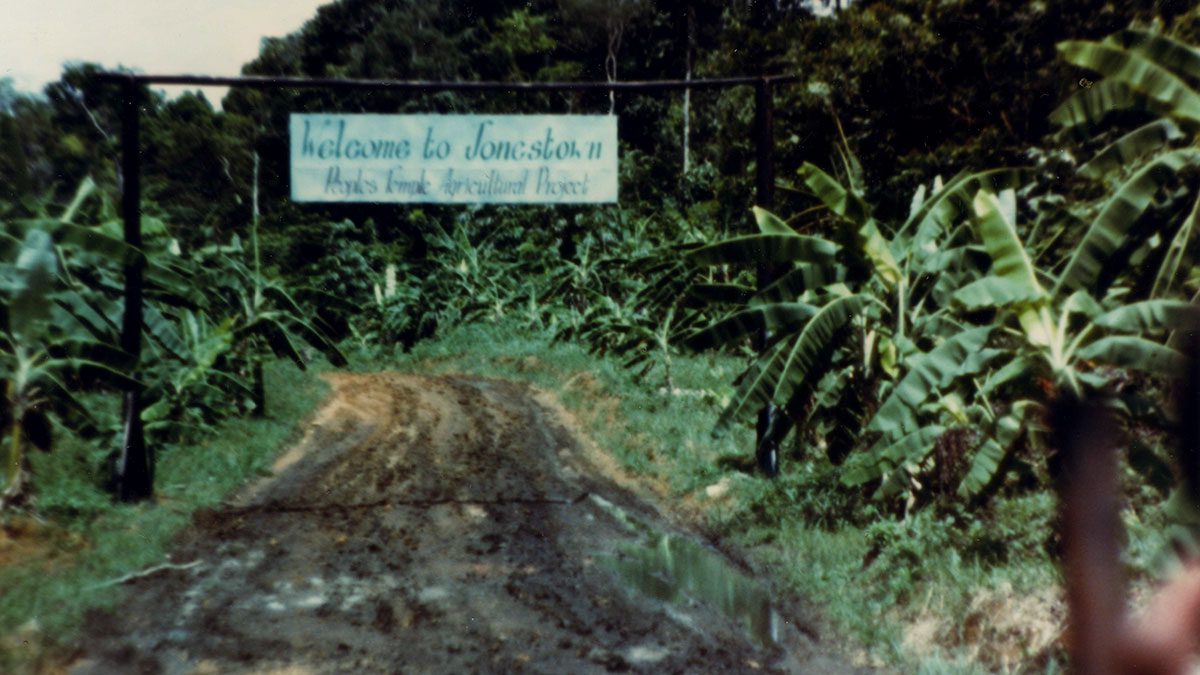
Jonestown was an agricultural settlement in the rainforest of Guyana, near the northern coast of South America, set up in 1974 by members of a church known as Peoples Temple, which had been founded in 1954 in Indianapolis by a preacher named Jim Jones. It was in Jonestown, in November 1978, that over 900 people were poisoned or otherwise killed – an act that Jones glorified as ‘revolutionary suicide’ but more closely resembled a massacre.
Although Peoples Temple had the trappings of a Christian church, the doctrine preached by Jones combined Christian and Oriental religious beliefs with political ideas taken from the American Communist Party. Jones claimed to be a reincarnation of both Jesus Christ and Lenin. Other heroes of Jones were Stalin, Mao, and Kim Il-Sung. Everything that Jones did from his late teens onward was done in the name of socialism and communism.
Survivors of Peoples Temple have kept in touch and built a partly online community of remembrance. Many have written about and tried to make sense of an ambiguous experience. A key role in this community is played by the Jonestown Institute, sponsored by the Department of Religious Studies at San Diego State University. The institute maintains a richly informative website and publishes an annual report. Both are open to contributions from anyone with something to say about Peoples Temple, regardless of political, religious, or philosophical viewpoint.
Here was an opportunity to offer members of this community a new perspective on Peoples Temple. I submitted four articles to the Jonestown Institute. They are listed with links on the page assigned to me on the institute’s website and also in the latest annual Jonestown Report.
My first article, Jim Jones: an attempt at psychic-political analysis, focuses on Jones as an individual. I suggest that Stalinism, as a system of domination supposedly aimed at ending domination, was well suited to psychic needs rooted in the severe neglect he suffered in early childhood.
The next article, Peoples Temple and socialism, questions the widely held assumptions that Jones was a socialist and Peoples Temple a socialist movement. I analyze Jonestown as a peculiar kind of class society and conclude that genuine socialism is impossible without democracy.
The third article argues that even within a highly authoritarian structure there may exist islands of autonomy.
The last article — Was Jonestown sustainable? — argues that the whole project of establishing such a large and permanent agricultural settlement in the middle of the rainforest may have been ecologically unsustainable.


